Slovenia voted on 4 questions. Do the numbers add up?
Verdict: no statistical traces of manipulation
I ran standard election-forensics tests on the official precinct-level results of the four referendums of 11 October 2026. Every test is consistent with an honest count. (99.98% of ballots counted at the time of analysis; final check of abroad votes — 19 October 2026.)
What was decided on 11 October 2026
Slovenia voted on four questions at once — one binding referendum on a law and three consultative ones. Every voter received all four ballots. National turnout: 54.6%.
Parliamentary Investigations Act (ZPPre-B)
Social assistance
Local voting rights
RTV Slovenia fee
Three reasons the numbers can be trusted
The arithmetic is perfect
All 12,332 precinct records add up exactly: YES + NO = valid votes, valid + invalid = ballots cast. And four separate counts ran at every precinct: in 93% of precincts the number of ballots is identical across all four; 99.6% differ by at most 2. Mass tampering cannot stay this consistent.
No anomalies where fraud would show
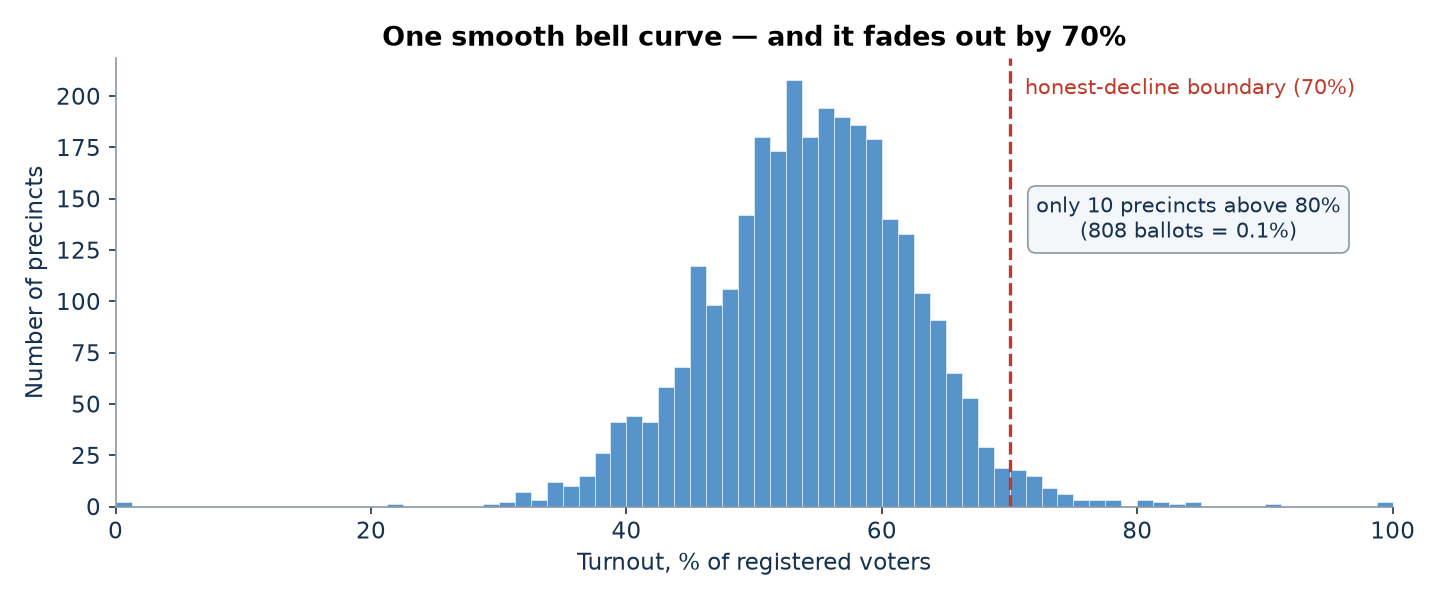
Precinct turnout forms one smooth bell curve that fades out by ~70%. Above 80% turnout there are only 10 tiny precincts — 0.1% of ballots. Stuffed ballot boxes leave the opposite signature: a visible mass of large precincts at 80–100% turnout. There is none. No spikes at round numbers, no digit patterns, no duplicated protocols.
The pattern is geography, not manipulation
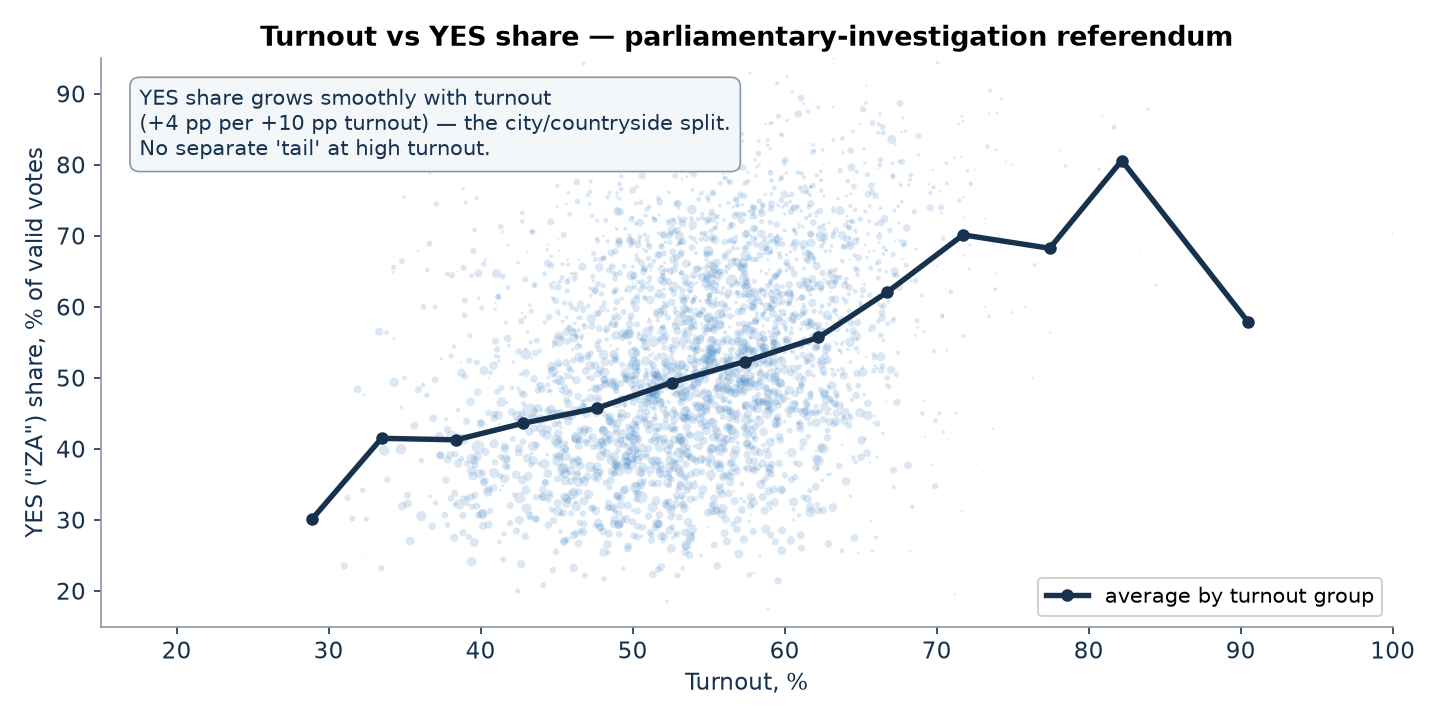
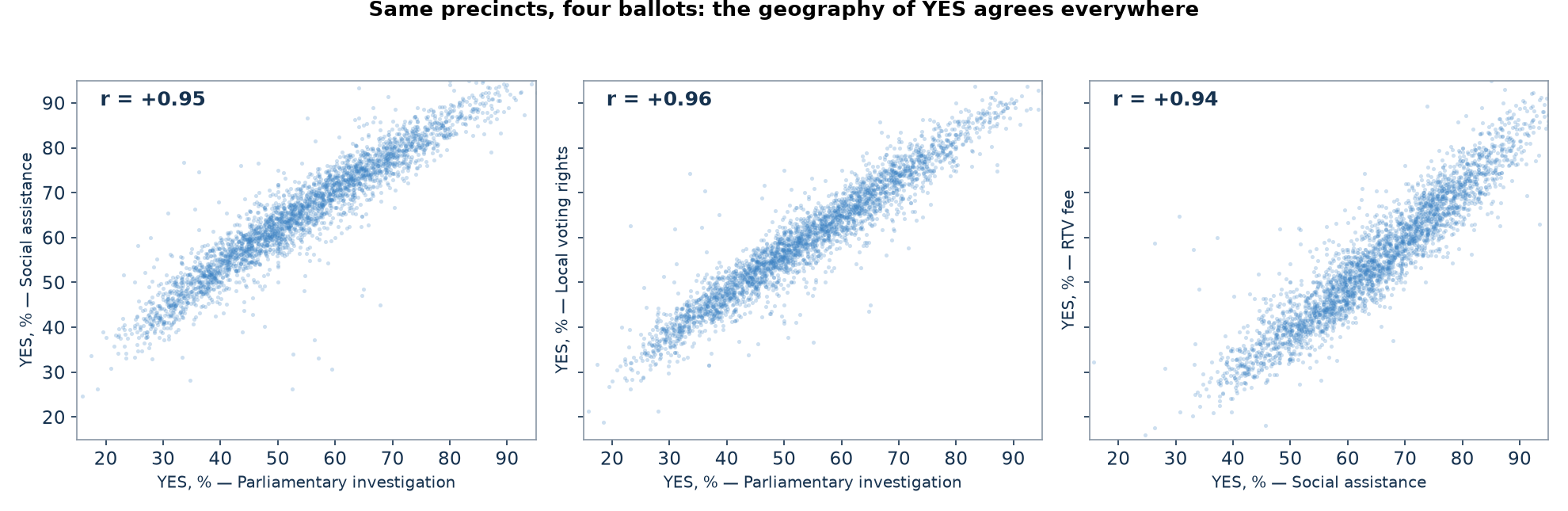
The YES share rises smoothly with turnout (+4 points per 10 points) — the familiar city-versus-countryside split. Crucially, all four questions show the same gradient (correlation 0.94–0.96). If one count had been tampered with, it would break ranks with the other three. None does.
How I checked
Eight families of tests used by election statisticians worldwide, run on the official precinct data with open-source code. Summary: all clean.
Anomalous-vote estimate (Shpilkin method)
Votes beyond the honest turnout decline: at most 1% of YES votes and 0.45% of NO votes — and removing them would shift any outcome by at most 0.15 points.
Turnout × result scatter (“comet tail”)
One continuous cloud with a smooth gradient — no separate “tail” of high-turnout, high-YES precincts that ballot-stuffing produces.
Election fingerprints (Klimek et al.)
The distribution matches honest elections; the specific 2D cluster typical of fraud (80–100% turnout) is absent.
Round-number peaks (Kobak et al.)
Protocol values show no preference for whole percentages of turnout or result (all statistics ≤ 1.3) — no sign of numbers typed in by hand.
Digit tests (Benford, last digit)
16 tests on vote counts: 13 fully clean, 3 borderline values with the opposite of the “fabricated numbers” profile — and not significant after multiple-testing correction.
Outliers vs neighbours + machine learning
A few dozen precincts flagged — all tiny (16–342 voters) with mixed directions; a normal statistical tail, not a pattern.
Duplicate protocols
Repeated result vectors occur at exactly the rate chance predicts (38–60 observed vs 37–53 expected). No copy-paste.
Self-test: the toolkit actually detects fraud
I injected synthetic ballot-stuffing into the data — the estimated anomalous zone grew 12-fold and every alarm fired. The “clean” verdict is a real measurement, not a blind spot.
What this analysis cannot see
Honest limits of the method — statistics shows anomalies, not intentions.
- Protocols and witnesses are not in the dataset. Statistics can confirm the numbers are mutually consistent; it cannot rule out manipulation that happened before the numbers existed (e.g. pressure on voters that is spread evenly).
- 9% of ballots have no precinct breakdown (early voting, postal, abroad). They were checked by digit tests and totals only.
- At the time of analysis 99.98% of ballots were counted (final check of abroad votes: 19 October 2026). Final numbers may move by dozens of votes — far too little to change any outcome.
- Precincts average ~460 voters, so the round-number test is insensitive to falsifying a small share of protocols (verified by self-test). Digit tests need thousands of numbers to be powerful.
- I am an independent researcher with no ties to the State Electoral Commission; all input files are official DVK publications and the analysis code is open source.
Data & reproducibility
- Source: official machine-readable results of the State Electoral Commission (DVK) at volitve.dvk-rs.si — precinct-level files for all four referendums, downloaded 13 October 2026 (server snapshot 12 October 2026, 99.98% counted).
- Cross-check: my totals match the Wikipedia summary table for all four referendums to the exact vote.
- Toolkit: open-source election-forensics pipeline (Python, pandas / scikit-learn) implementing Shpilkin, Klimek, Kobak, Beber–Scacco and other methods.
- Full technical report (in Russian), precinct data files and analysis scripts are available in the project repository.